The University of Helsinki supplementary courses
TypeScript and relational databases as a bridge between interface code and backend data
- TypeScript
- React
- Node.js
- PostgreSQL
- SQL
- JEST
Strengthening the contracts across an application
After the core Full-stack Open course, I completed the TypeScript and relational database parts. They helped me connect interface code, API contracts, and persistent data more deliberately. These notes focus on those two completed courses and the foundations I carried into project work.
The Typescript (Part 9)
The TypeScript section of the University of Helsinki's supplementary courses provides a deep dive into one of the most widely used typed languages in modern web development. TypeScript, an open-source superset of JavaScript developed by Microsoft, enhances JavaScript by introducing static types, improving code maintainability, and reducing runtime errors.
The TypeScript course content
In this part, learners will build end-to-end features within an existing ecosystem, working with a predefined codebase and linters while writing TypeScript. The course aims to provide hands-on experience in configuring and developing TypeScript-based projects, preparing students for real-world applications.
- Background and Introduction – Understanding the purpose and benefits of TypeScript
- First Steps with TypeScript – Setting up a TypeScript project and learning fundamental concepts
- Implementing TypeScript in a backend environment with Express
- React with Types – Applying TypeScript to React projects for better component safety and reusability
- Grande Finale: Patientor – A comprehensive project where students build a healthcare application using TypeScript
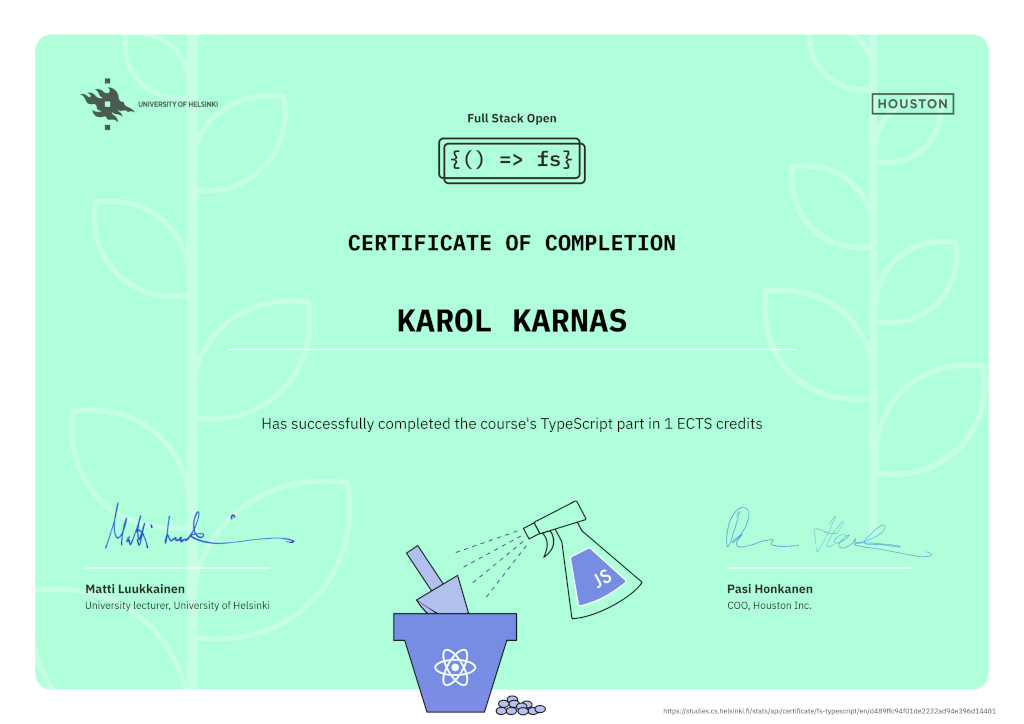
Typing both Express responses and React components made the connection between the two sides clearer. The Patientor project gave me practice working within an existing application rather than starting from a blank file. Those habits carry into my full-stack work: make the data contract explicit, validate external input, and let the type system help trace a change through its callers.
Using Relational Databases (Part 13)
The relational databases section of the University of Helsinki's supplementary courses provides an in-depth look at SQL-based databases in modern web development. While previous sections focused on NoSQL databases like MongoDB, this part explores relational databases, their resurgence, and how they have adapted to modern scalability challenges. PostgreSQL, the leading open-source relational database, is the primary focus.
The Relational Databases course content
In this section, learners will work with relational databases in Node.js applications, focusing on PostgreSQL. The course covers essential database concepts, from setting up Sequelize as an ORM to handling migrations and complex queries.
- Using relational databases with Sequelize – Setting up Sequelize and interacting with PostgreSQL
- Join tables and queries – Understanding relationships between tables and writing optimized queries
- Migrations and many-to-many relationships – Structuring data efficiently and managing schema changes
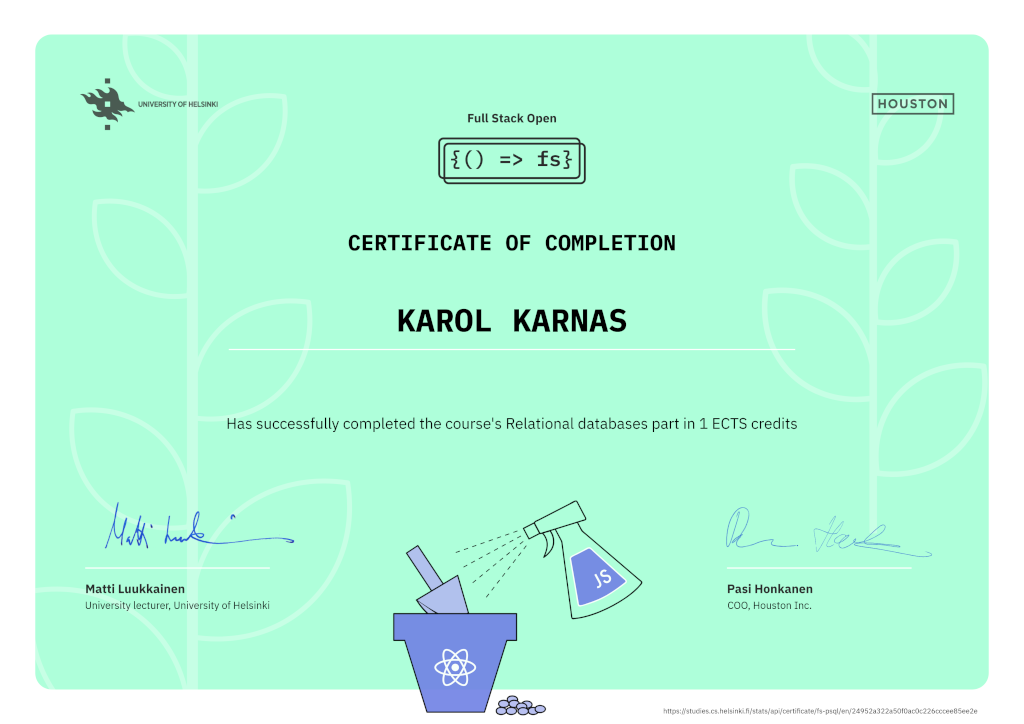
The relational database work gave me a stronger foundation for schemas, joins, and migrations. Those decisions influence what an API can return and what an interface can show. I use that connection when building a feature across the stack: the visible behavior and the stored relationships need to support the same workflow.